Cities in Bangladesh are changing rapidly. New flyovers, residential buildings, road expansions, and mega projects—signs of development are visible everywhere. But behind this visible progress lies an invisible crisis—construction dust. Discussions on air pollution usually revolve around vehicle emissions or industrial discharge; however, the contribution of construction-related “fugitive dust” to urban air degradation is highly significant. During construction, large amounts of fine particles are released into the air from sand, cement, brick dust, and soil. Some of these particles are classified as PM10 (particles smaller than 10 micrometers), while even finer ones fall under PM2.5. These particles can enter the human body through breathing and cause inflammation. Over time, they increase the risk of respiratory problems, asthma, heart disease, and other complications.
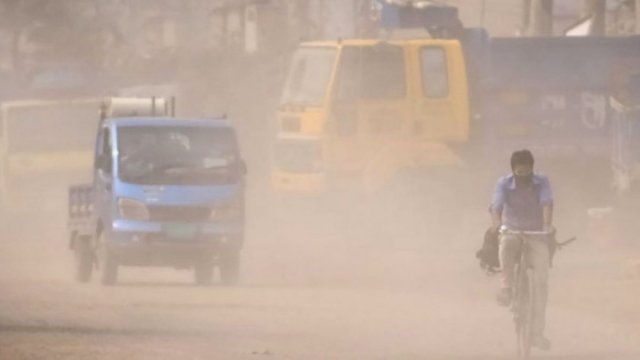
The World Health Organization has clearly stated that long-term exposure to high levels of particulate pollution is harmful to public health. In other words, construction dust is not a temporary inconvenience—it is a growing health risk. On a typical morning in the city, what catches the eye first is not just traffic congestion, but a faint gray haze hanging in the air. This is not natural fog; it is a layer of dust floating in the name of development. A large truck passes by, and for a few seconds, visibility drops significantly. Through the dense curtain of dust, the vehicle ahead becomes almost invisible.
Pedestrians walk with covered faces, and shopkeepers repeatedly sprinkle water in front of their stores to control the dust—only for it to settle again within minutes. Nearby, construction work continues. Sand is piled in open spaces, easily dispersing into the surrounding air. In many cases, no regular water spraying is done to control the dust. Construction sites lack proper barriers, and uncovered trucks transport materials, shedding debris and dust along the roads. These scenes have become so common that we no longer consider them unusual. This is where the depth of the problem lies. Dust is no longer just in the air—it has settled into our mindset. We have come to accept it as an inevitable part of development, as if progress must come with a layer of dust. But scientific reality tells a different story. These fine particles (PM10 and PM2.5) enter our respiratory system and increase long-term health risks. In urban life, dust is no longer just an environmental issue—it has become a social norm. And when a problem is normalized, it slips down the list of policy priorities. In the case of construction dust and air pollution, there is not only a gap in policy enforcement but also a lack of individual and social awareness. Often, we treat this issue as entirely the government’s responsibility, ignoring how our daily behavior contributes to pollution. At the individual level, during house construction or renovation, materials like sand and cement are often left uncovered.
In many cases, roads are used as storage spaces for bricks, stones, and sand. Trucks operate without covers, and the importance of water spraying at construction sites is ignored. Rarely do we consider how much dust nearby residents, pedestrians, or school-going children are exposed to. A common mindset persists: “This is temporary—once the work is done, everything will be fine.” But scientific evidence shows that repeated and prolonged exposure to dust has cumulative health impacts. Pollution does not kill instantly; it slowly damages the body over time. Another major issue is our habitual tolerance. We have accepted dust as an unavoidable part of development. When our eyes burn while walking through dusty roads, we simply turn away instead of protesting. Even when we feel discomfort from uncovered trucks, we rarely file complaints. As a result, there is no social pressure, and violating rules becomes easy. The lack of awareness is not just behavioral—it is also informational. Many people are unaware that PM2.5 particles can directly enter the bloodstream. Pollution is often seen as a minor discomfort rather than a serious long-term health risk, which reduces the urgency to act. An important point to note is that air is not a private resource. Dust from one construction site affects everyone nearby. This means individual decisions have collective consequences. Public health is an area where individual negligence turns into shared risk.
Therefore, the solution must be multidimensional. On one hand, strict policy enforcement is needed; on the other, a strong sense of civic responsibility must be developed. Measures such as dust control planning before construction, ensuring covered transportation of materials, and building local awareness must become social norms. When society itself rejects rule violations, policy enforcement becomes stronger. Air pollution is not an abstract environmental statistic—it is the air we breathe every day, and the risks we face every day. Construction dust, uncovered trucks, and poorly managed materials may seem like small issues, but together they create a major urban air crisis. This is not just a technical problem—it is a matter of priorities, enforcement, and awareness. For policymakers, clean air is not a luxury—it is the foundation of public health. And for citizens, responsible behavior is not an extra duty—it is a social obligation. Development becomes truly sustainable only when infrastructure growth is accompanied by the assurance of clean air. Cities are changing rapidly. What is needed now is stronger policies, effective implementation, and a shift in public awareness. Because air belongs to everyone—and it is the first and last element that sustains our lives. The true measure of development will not be how many tall structures we build, but how clean the air we leave behind.