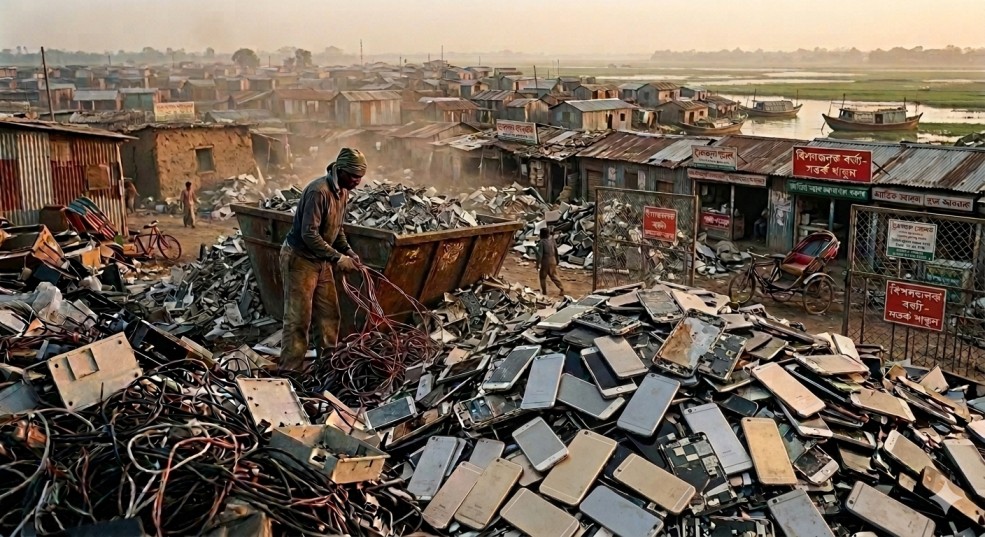
In September 2026, Apple is rumored to launch the iPhone 18 Pro Max featuring a variable aperture lens, bringing a DSLR-like photography experience to smartphones. Fascinating, isn't it? But have you ever wondered what happens to these devices after just a few months or years of use?
Like any other electronic gadget, household appliance, office equipment, or machinery, an iPhone eventually reaches the end of its life. In Bangladesh, it becomes part of the country's rapidly growing electronic waste (e-waste) stream, which reached approximately 3 million metric tonnes (3 billion kilograms) annually as of July 2026 [1].
The most alarming aspect of e-waste is not merely its increasing volume but the hazardous substances it contains. Toxic metals such as lithium (Li), lead (Pb), cadmium (Cd), and mercury (Hg) gradually leak into the air, soil, and water as discarded electronic products deteriorate [2], [3]. According to a study by Widmer, heavy metals account for 2.7% of total e-waste, equivalent to nearly 81,000 metric tonnes of hazardous materials generated every year in Bangladesh [4]. Exposure to these toxic metals through contaminated air, water, or food can lead to neurological disorders, kidney damage, skin diseases, and numerous other serious health complications [2], [6], [8].
The only effective way to reduce these risks is through a safe and efficient e-waste management system. Unfortunately, Bangladesh currently recycles less than 10% of its total e-waste at a limited number of licensed recycling facilities [1]. The remaining waste is dumped into landfills, openly burned, or dismantled in informal recycling workshops where proper safety equipment and health protocols are rarely followed.
This informal recycling sector also relies heavily on child labor. Approximately 50,000 street children are involved in the unauthorized collection and recycling of electronic waste. Studies indicate that 83% of these children suffer from poor health conditions, while nearly 15% die due to prolonged exposure to toxic substances found in e-waste [2], [8], [9].
The consequences extend beyond the workers themselves. Communities living near informal recycling sites are also exposed to serious environmental and health hazards. In the north-eastern regions of Bangladesh, around 36.3% of women residing close to e-waste recycling sites reportedly experienced the loss of a child [2], [8], [9]. Moreover, contamination can travel far beyond the recycling locations. A study conducted in China found that 23% of children surveyed in Chendian Town had elevated levels of lead in their blood, despite living nearly 10 kilometers away from the informal recycling hub in Guiyu. Unsafe manual recycling practices allowed toxic pollutants to spread across neighboring communities [10].
These findings clearly demonstrate that Bangladesh's current e-waste management system has significant shortcomings. Under the Hazardous Waste Management Rules, manufacturers, distributors, and other relevant stakeholders are expected to collect 50% of e-waste for proper disposal or recycling by the fifth year following the implementation of the rules in 2021. However, there is still no reliable national inventory or tracking mechanism to evaluate whether this target has been achieved [5], [7].
At present, Bangladesh lacks an integrated e-waste management framework that includes authorized collection centers, sufficient formal recycling facilities, standardized treatment processes for non-recyclable waste, and comprehensive occupational health and safety measures [2].
To prevent the situation from worsening, coordinated action is urgently needed. The Government of Bangladesh, researchers, industries, NGOs, development partners, and international organizations must work together to establish an environmentally sound, end-to-end e-waste management system—from product design and manufacturing to collection, recycling, and final disposal.
Building such a circular economy is not only essential for protecting public health and the environment but also presents an opportunity to generate sustainable livelihoods, create green jobs, recover valuable resources, and support Bangladesh's transition toward a more resilient and resource-efficient future.
References:
1. Dialogue urges stronger regulation to tackle Bangladesh's e-waste problem.
https://www.thedailystar.net/next-step/news/dialogue-urges-stronger-regulation-tackle-
bangladeshs-e-waste-problem-4235546
2. E-waste management in Bangladesh: Environmental impacts, health risks, and
sustainable policy strategies. https://doi.org/10.1016/j.clwas.2025.100297
3. Assessing the environmental impact and risks associated with uncontrolled disposal of
end-of-life lithium-ion batteries on soil. https://doi.org/10.1016/j.mex.2025.103576
4. Global perspectives on e-waste. https://doi.org/10.1016/j.eiar.2005.04.001
5. E-Waste Management in Bangladesh: Governance Challenges and Way Forward.
Transparency International Bangladesh.
6. E-WASTE-AN EMERGING PUBLIC HEALTH THREAT: BANGLADESH
PERSPECTIVE. https://doi.org/10.3329/jopsom.v41i1.66646
7. Electronic Waste (E-Waste) and Its Impacts in Bangladesh: An Evaluation of Existing
Laws and Implementation Process. https://www.ewaste1.com/what-is-e-waste
8. A Review on the environmental and health impacts due to electronic waste disposal in
Bangladesh. https://doi.org/10.30574/gscarr.2021.8.2.0174
9. E-waste Management and Environmental Sustainability in Bangladesh: Existing policies
and policy gaps. Voices for Interactive Choice and Empowerment.
10. Elevated Blood Lead Levels of Children in Guiyu,